Establishing a Unified Cost Data Model for Category-Level Decisions
Cost visibility wasn’t the problem.
Decision clarity was.
This work focused on redesigning how category managers made high-impact cost decisions across fragmented systems, incomplete data, and regulatory constraints.
Company: Kroger
My Role: Product Design Lead
Scope: Internal, cross-functional decision systems supporting item to category level pricing and data-heavy workflows for complex operational decision-making
Constraints: Fragmented data sources, legacy systems, regulatory requirements, and downstream dependencies
The Real Problem
Category managers were making frequent, high-impact cost decisions using data that was:Fragmented across legacy systemsInterpreted differently across teamsStructurally rigid and slow to reconcileProne to downstream operational risk
Existing tools aggregated data — but they did not clarify the decision space.This led to:Workarounds and shadow trackingDuplicate analysis across teamsTiming misalignment across categoriesIncreased exposure to pricing and margin risk
The system optimized for visibility.
It did not optimize for judgment.
Reframing the Decision Space
At its core, cost management required four recurring decisions:Approve or defer cost changesValidate and resolve exceptionsAssess downstream margin impactCoordinate timing across categories
These were not UI problems.
They were decision architecture problems.
The opportunity was to design around the decision logic itself.
Why This Was Hard
The challenge wasn’t a lack of data.It was the interaction between:Multiple teams interpreting cost signals differentlyLegacy systems enforcing structural rigidityRegulatory and audit requirementsHigh cost of timing errors
This required balancing flexibility with governance — clarity with compliance.My Responsibility
I led the reframing of the problem from “data visibility” to “decision architecture.”This included:Mapping recurring decision patterns across categoriesSurfacing tradeoffs and failure modesDesigning a shared model that scaled beyond a single workflowAligning product, engineering, finance, and operations around a unified structure
The result was not just a new interface.It was a system designed for confident, timely decision-making.Outcomes (Operational Impact)
The redesigned decision architecture improved clarity, coordination, and execution speed across cost workflows.
Reduced escalation cycles between merchandising, finance, and operations
Decreased manual reconciliation across divisions
Improved timing alignment for cost change execution
Increased confidence in margin-impact decisions through structured auditability
Escalation cycles were reduced by approximately 15% after aligning teams around shared cost interpretation logic.
Organizational Impact
The work shifted cost management from fragmented interpretation to shared decision logic.As a result:Cost signals were interpreted consistently across categoriesEscalation cycles between merchandising, finance, and operations were reducedMargin-impact decisions were made with greater confidence and auditabilityGovernance scaled without increasing coordination overhead
The organization moved from reactive data reconciliation to proactive decision orchestration.
The Unified Cost Model (In Practice)
Instead of reconciling fragmented cost tables across systems, we created a shared category-level view aligned around decision logic.
The Unified Cost View
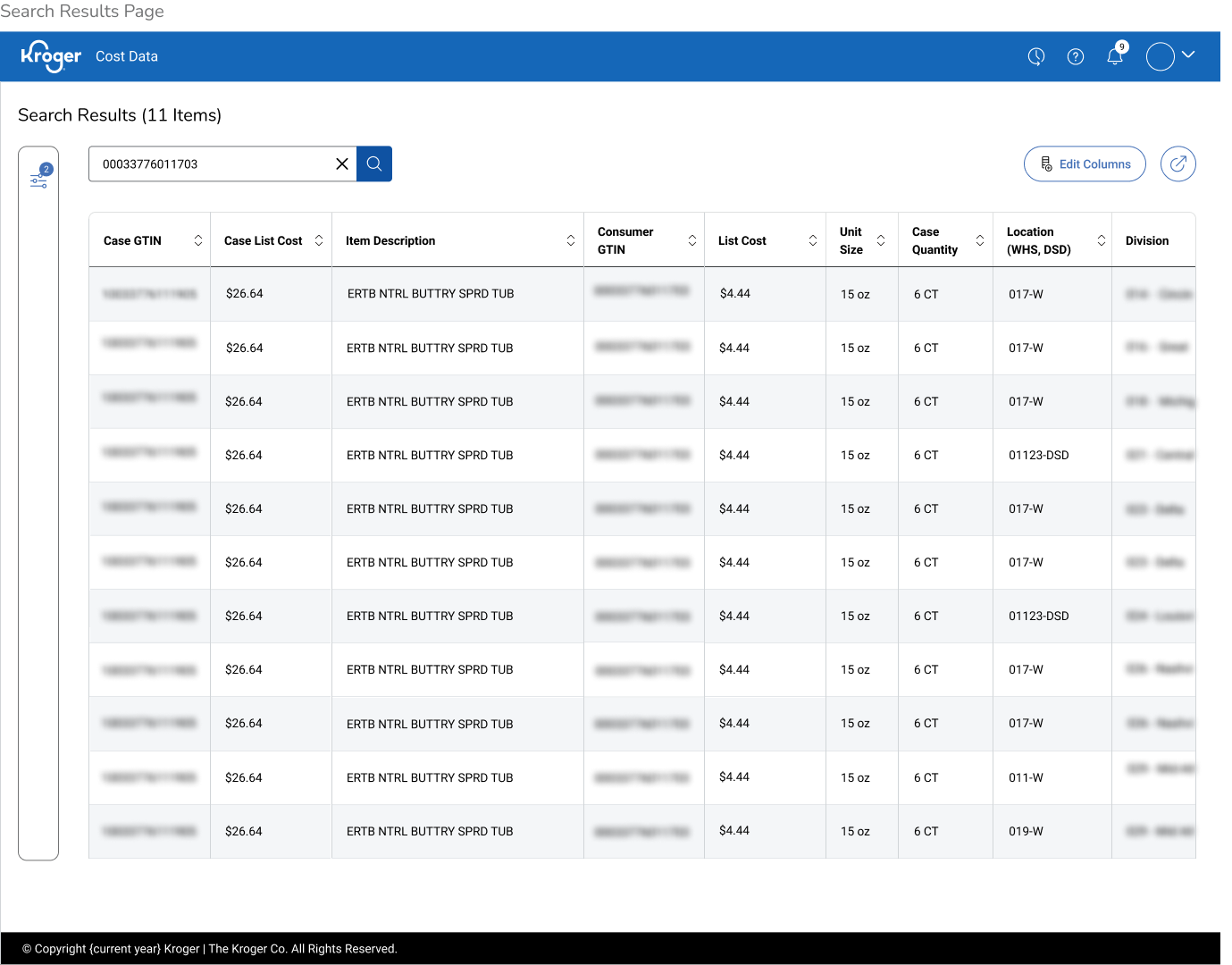
This view:
Standardized cost interpretation across divisions
Unified case and consumer GTIN relationships
Surfaced downstream impact indicators
Enabled category-level coordination without manual reconciliation
This was not a reporting artifact.
It operationalized shared decision logic across divisions.
Making Time & Risk Explicit
High-impact cost decisions are rarely about the current number.
They are about timing, margin exposure, and downstream impact.
We introduced structured views for:
Historical cost changes
Upcoming cost changes
In-progress adjustments
Effective dates and audit trails
Historical & Future Cost Panels
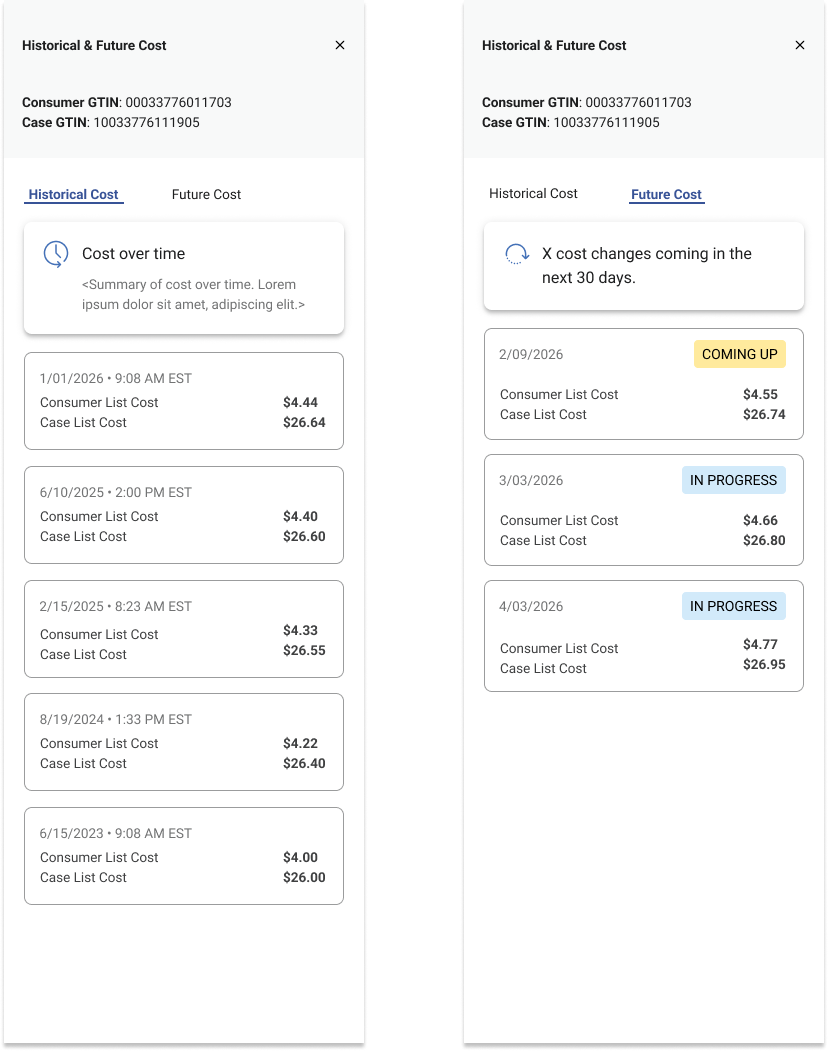
This allowed category managers to:
See upcoming margin impact before execution
Coordinate timing across categories
Validate exceptions before approval
Reduce escalations driven by misaligned effective dates
Instead of static cost visibility, we created temporal decision clarity.
Rather than organizing around systems or data sources, we structured the model around:Inputs required to support judgmentShared decision logic across teamsOperational outcomesExplicit constraints and trust mechanismsBy centralizing the decision logic layer, we reduced interpretive drift across teams and created a unified mental model for cost evaluation.