Designing a Context-Aware Recommendation System for Scalable Product Discovery
This work focused on designing a governed recommendation system that balanced personalization, business performance, and customer trust across digital commerce surfaces.
Company: Macy’s
My Role: Product design lead partnering with product, engineering, data, and merchandising teams
Scope: Designing recommendation strategies and surfaces across digital touchpoints to improve product discovery while balancing personalization, business goals, and customer trust
Constraints: Data quality variability, performance requirements, merchandising rules, and customer perception of relevance
The Problem
Teams were required to make frequent, high-impact decisions using incomplete and inconsistently structured data. Existing systems prioritized data aggregation over trust and decision clarity, leading to workarounds, duplicated effort, and increased operational risk.
Why This Was Hard
How the Recommendation System Actually Worked

The challenge was not a lack of data or effort, but the interaction between:
Multiple teams interpreting the same cost data differently
Legacy systems with rigid structural constraints
A high cost of errors driven by inaccurate or delayed information
My Responsibility
My responsibility was to bring clarity to the decision space—aligning teams around shared mental models, surfacing tradeoffs, and designing systems that could scale beyond a single workflow.
Designing the Recommendation Decision Layer
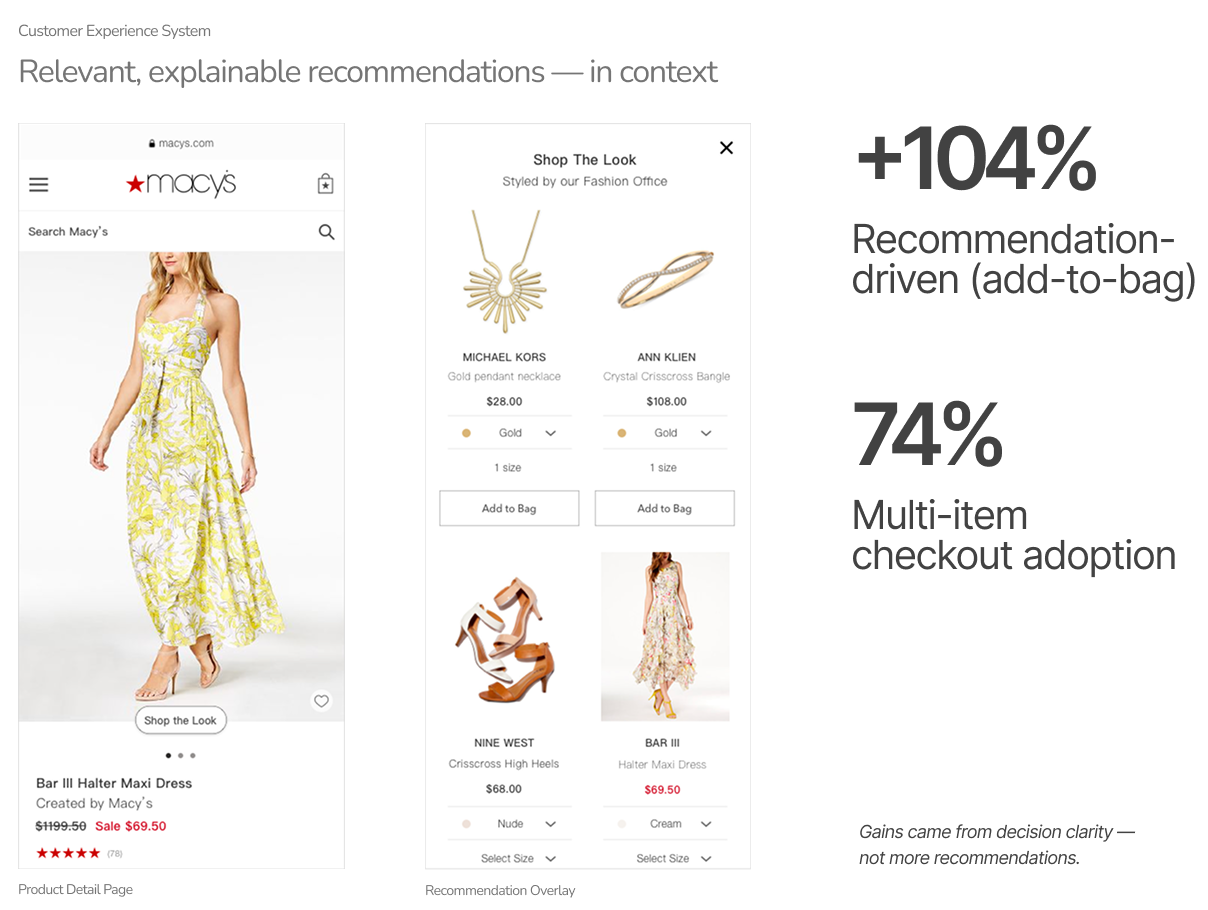
Recommendations were surfaced contextually across PDP and overlay experiences — driven by shared decision logic rather than isolated merchandising rules.
By centralizing recommendation logic and clarifying decision rules, we increased engagement while reducing friction between personalization and merchandising constraints.

Reframing the System
Rather than optimizing individual recommendation placements, we reframed the problem around a shared decision architecture.
At its core, the recommendation system required four structured layers:
Signals (customer + business inputs)
Decision rules (inclusion, exclusion, thresholds)
Contextual ranking logic
Trust and governance constraints
This shifted the work from UI tuning to system design.
Approach
1) Clarify decision logic before redesigning surfaces
We mapped existing merchandising rules, personalization signals, and business constraints across PDP, cart, and category surfaces.
This revealed inconsistencies in how relevance thresholds and exclusions were applied.
2) Separate rules from ranking
We created a structured decision model that:
Defined what qualifies an item (rules)
Determined ordering based on context (ranking)
Embedded trust constraints (inventory accuracy, over-personalization limits)
This reduced rule drift and prevented surface-level overrides.
3) Embed trust as a system constraint
Trust was not treated as a final check.
It informed:
Eligibility logic
Ranking adjustments
Final output constraints
This ensured recommendations were explainable and operationally safe.
The System in Practice
Recommendations were surfaced contextually across PDP and overlay experiences — powered by shared decision logic rather than isolated placement rules.
By centralizing rule definition and contextual ranking, we increased engagement while reducing friction between personalization and merchandising constraints.
Outcomes (Metrics)
This work delivered measurable product impact and structural system improvement:
+104% increase in recommendation-driven add-to-bag interactions
74% multi-item checkout adoption among recommendation users
Reduced merchandising rule overrides across surfaces
Improved alignment between data, merchandising, and engineering teams
The gains came from clarified decision logic — not increased recommendation volume.
Organizational Impact
The work shifted recommendations from surface-level optimization to governed decision architecture.
As a result:
Recommendation logic became reusable across digital commerce surfaces
Merchandising rules were standardized instead of duplicated per placement
Personalization, business constraints, and trust were aligned within a shared framework
Future experimentation could occur without reworking foundational logic
The system moved from reactive rule management to structured decision orchestration.
What Changed
Before:
Rules embedded in surfaces
Personalization tuned per placement
Trust constraints reactive
After:
Centralized decision layer
Contextual ranking applied consistently
Trust embedded across the system
This created a scalable foundation for product discovery beyond a single surface or campaign.
Rather than designing around surfaces or placements, we structured the recommendation system around a shared decision layer — separating signals, business rules, ranking logic, and trust constraints.
The System in Practice