Scaling Financial Learning Across Platforms
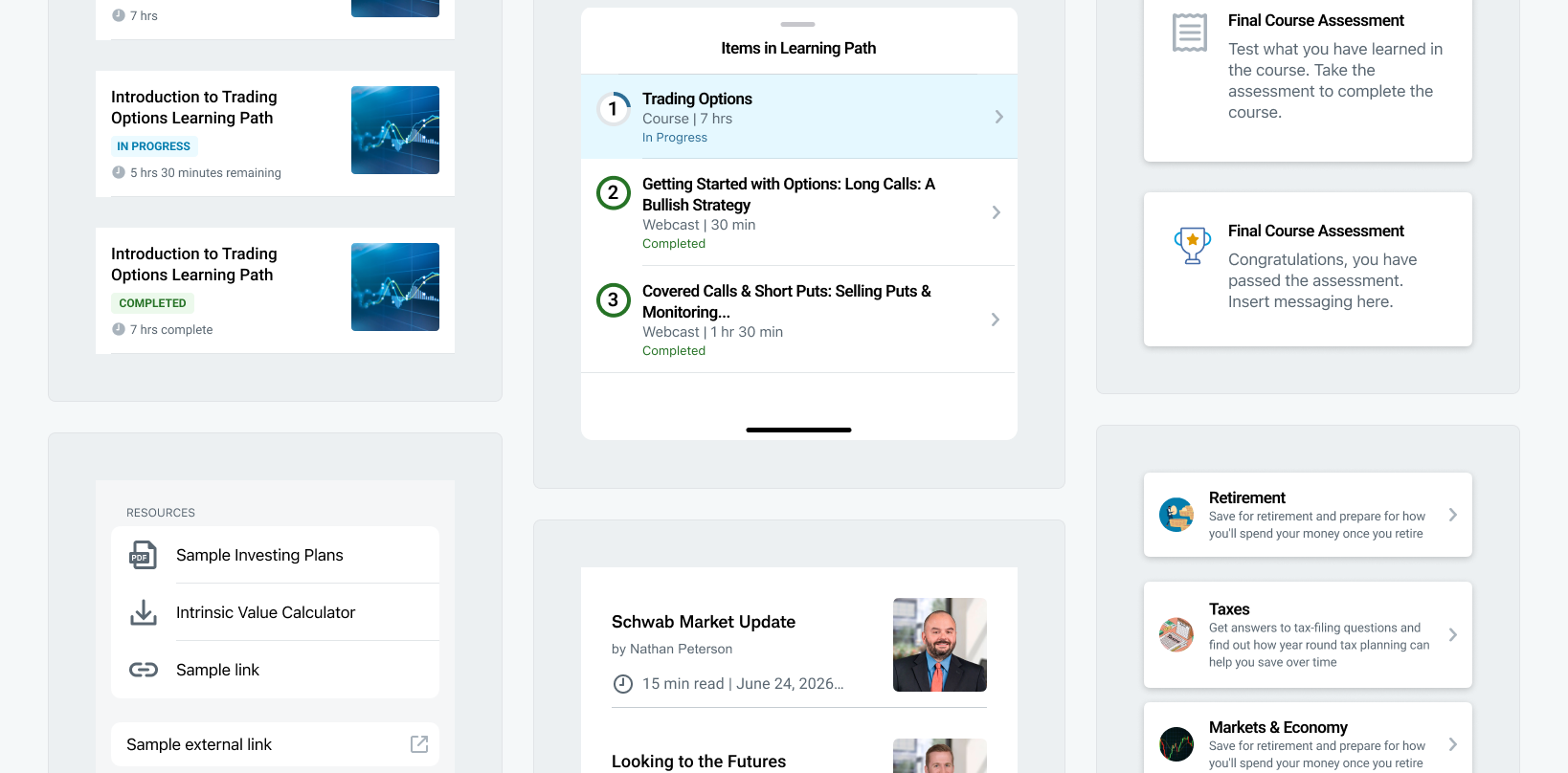
Migrated legacy learning experiences into Schwab while redesigning for responsive web and app, stabilizing performance through transition and establishing reusable components adopted across business units.
Company
Charles Schwab
MY ROLE
Principal Product Designer
SCOPE
Migration + Redesign
CONSTRAINTS
Legacy Structures, Cross-Platform Parity, Accessibility Requirements
The Challenge of Scale
The primary hurdle was reconciling decades-old legacy
codebases with modern design requirements. We
needed a solution that was performant on mobile
without sacrificing the depth of information required for
high-stakes financial education.
“The system didn’t just need a
facelift; it needed a fundamental
restructuring of how data flows
through the interface.”
Approach & Solution
A multi-phased digital transformation focusing on the intersection of legacy content architecture and modern user expectations.
Translate Legacy Content
Auditing thousands of training assets to map
outdated formats into a cohesive, structured content hierarchy optimized for accessibility.
Ship Iteratively
Continuous deployment cycles allowed for real-world feedback loops from store associates, refining the UI based on actual usage telemetry.
Define Reusable Components
Developing a modular library of "Instructional Atoms" that ensure consistency across web, tablet, and handheld handheld devices.

Outcomes & Growth
The transformation resulted in measurable improvements across key performance indicators, proving that design-led strategy impacts the bottom line.
Stable course traffic throughout the migration
New registrations for learning content increased across Schwab + TDA client segments
The Operating Model & Structural Shifts
Beyond the interface, we re-architected how Kroger's digital products are conceptualized, built, and maintained across the enterprise.
Unified Information Architecture
Breaking down silos between grocery, pharmacy, and fuel to create a single, intuitive mental model for the customer.
Modular Commerce Patterns
Standardizing cart actions, product cards, and checkout flows to ensure consistency regardless of the vertical.
Accessibility-First Standards
Embedding WCAG 2.1 compliance into the base layer of the design system, making inclusive design a non-negotiable default.
Real-time Feedback Loops
Deploying automated instrumentation to track component performance and user friction in production environments.
I treated this as a systems migration, not a redesign. I aligned teams around a shared model, defined component standards and states up front, and partnered with the design system team early to ensure what we shipped could scale.
Building for the next billion.
Interested in how we leverage modular architecture to drive enterprise-wide transformation? Let's discuss your next system.